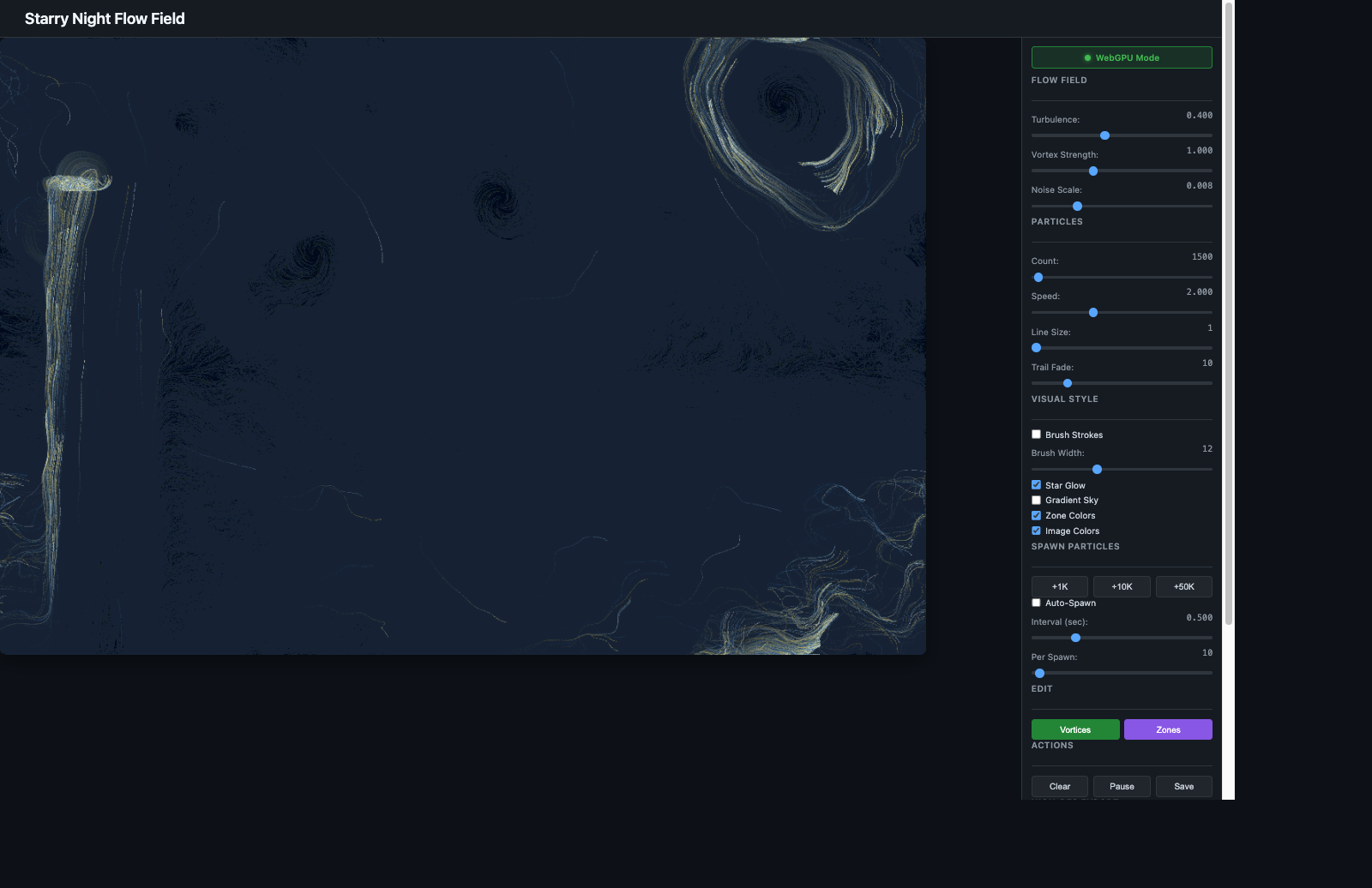
WebGPU-accelerated particle flow field visualization inspired by Van Gogh's Starry Night.
https://github.com/davidbmar/art-starry-night-flowfield · public · shipped
A real-time generative art engine that simulates fluid dynamics using curl noise and interactive vortices. It renders 50,000+ particles at 60 FPS by leveraging WebGPU for compute-intensive physics and rendering, with a CPU fallback via p5.js. The system samples colors from a reference image or palette to create painterly, impasto-style strokes that mimic the movement and color theory of Van Gogh's work.
python3 server.py
open http://localhost:8000
flowchart TD
    User[User Browser] -->|Interacts| UI[p5.js Sketch / UI]
    UI -->|State Updates| Bridge[WebGPU Bridge]
    Bridge -->|Uniforms/Storage Buffers| GPU[WebGPU Device]

    subgraph WebGPU Pipeline
        ComputeNoise[Compute Shader: Noise]
        ComputeFlow[Compute Shader: Flow Field]
        ComputeParticles[Compute Shader: Particle Physics]
        RenderPass[Render Pass: Particles & Trails]
    end

    GPU -->|Dispatch| ComputeNoise
    ComputeNoise -->|Noise Texture| ComputeFlow
    Bridge -->|Vortex Data| ComputeFlow
    ComputeFlow -->|Vector Field| ComputeParticles
    ComputeParticles -->|Particle Positions| RenderPass
    RenderPass -->|Draw Calls| Canvas[HTML5 Canvas]

    subgraph CPU Fallback
        CurlJS[CurlNoise.js]
        VortexJS[Vortex.js]
        ParticleJS[Particle.js]
        BrushJS[Brush.js]
    end

    UI -->|Fallback Mode| CurlJS
    CurlJS --> VortexJS
    VortexJS --> ParticleJS
    ParticleJS --> BrushJS
    BrushJS --> Canvas
The application uses a hybrid architecture. A p5.js sketch manages the UI, DOM interactions, and CPU-based rendering fallback. For high-performance mode, it initializes a WebGPU device via ES modules. Compute shaders (WGSL) handle simplex noise generation, flow field calculation, and particle physics integration. A bridge layer synchronizes JavaScript state (vortex positions, turbulence levels) with GPU uniform buffers. Render shaders draw particles with trail fading and brush-like tapering effects.
sequenceDiagram
    participant User
    participant P5 as p5.js Sketch
    participant Bridge as WebGPU Bridge
    participant GPU as WebGPU Device

    User->>P5: Interact (Click/Drag/Scroll)
    P5->>P5: Update Vortex/Config State
    alt WebGPU Enabled
        P5->>Bridge: syncState
        Bridge->>GPU: writeBuffer (Uniforms/Storage)
        GPU->>GPU: Dispatch Compute (Noise)
        GPU->>GPU: Dispatch Compute (Flow Field)
        GPU->>GPU: Dispatch Compute (Particle Physics)
        GPU->>GPU: Begin Render Pass
        GPU->>GPU: Draw Particles
        GPU->>P5: Present Frame
    else CPU Fallback
        P5->>P5: calculateCurlNoise
        P5->>P5: updateParticles
        P5->>P5: drawBrushStrokes
        P5->>User: Render Canvas
    end
Use this project as a foundation for high-performance web-based particle systems. It demonstrates how to offload physics calculations to WebGPU compute pipelines while maintaining a familiar p5.js development workflow for UI and interaction. It is suitable for data visualization requiring fluid motion, interactive digital art installations, or educational demos of curl noise and vector fields.
✓ all on main — nothing unmerged.