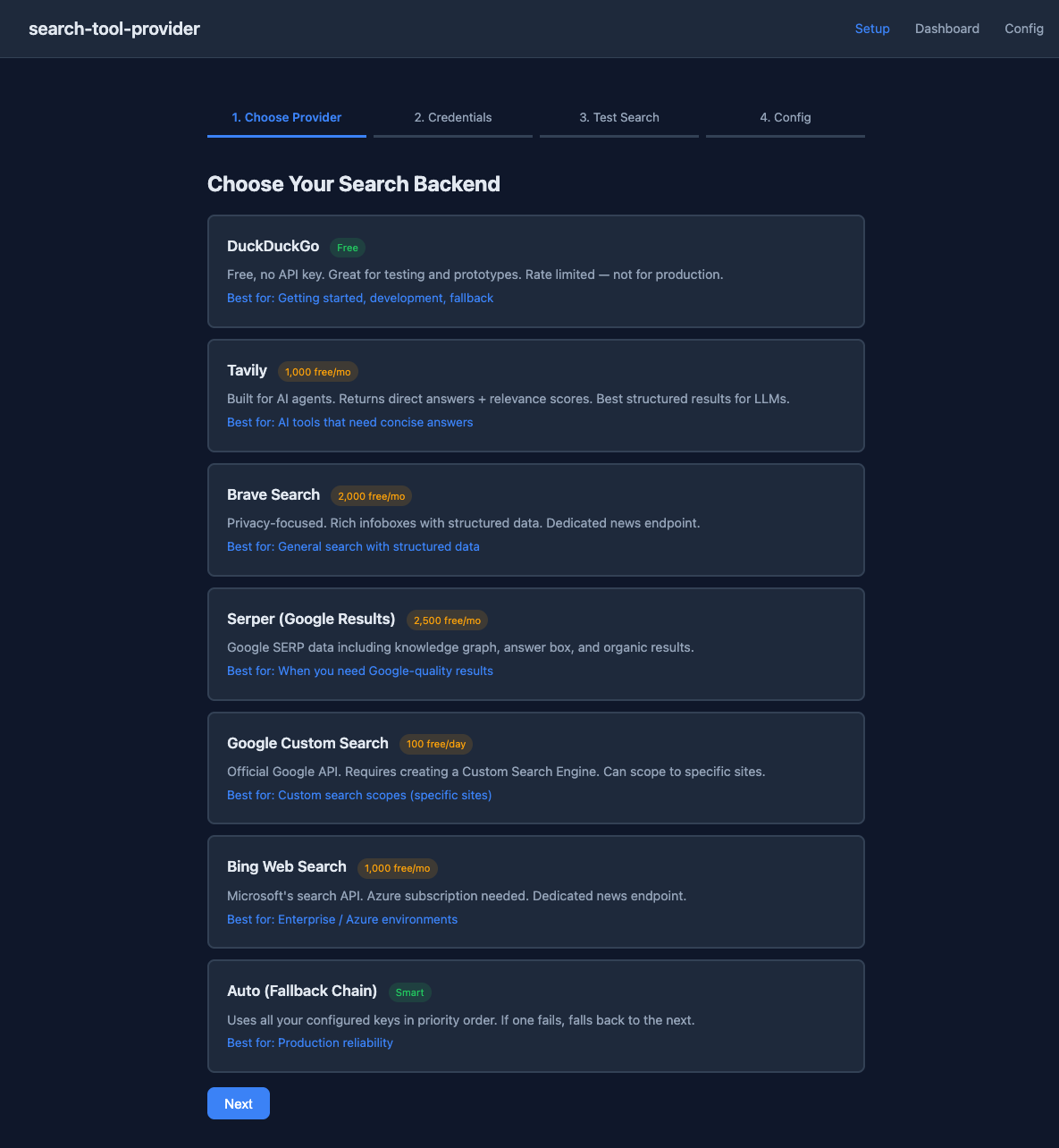
Unified async web search interface supporting 6+ backends with MCP server, CLI, and admin UI.
https://github.com/davidbmar/search-tool-provider · public · shipped
A Python library that abstracts multiple web search engines (DuckDuckGo, Tavily, Brave, Serper, Bing, etc.) behind a single asynchronous API. It provides a registry pattern for swapping providers, built-in fallback chains, caching, and structured response models. It includes three interfaces: a programmatic Python API, an interactive Rich-based CLI, and a FastAPI-based Admin UI with a configuration wizard.
pip install search-tool-provider[duckduckgo,cli]
search-provider-cli
flowchart TD
    User[User/Agent] -->|Python API| App[Application]
    User -->|CLI| CLI_App[CLI Interface]
    User -->|Browser| Admin_UI[Admin UI FastAPI]

    subgraph Core_Library[search-tool-provider]
        Registry[Provider Registry]
        ABC[SearchProvider ABC]
        Models[Data Models]
        Env[Env Manager]
    end

    App --> Registry
    CLI_App --> Registry
    Admin_UI --> Registry

    Registry -->|Instantiates| Provider_Instance[Concrete Provider]

    subgraph Backends[External APIs]
        DDG[DuckDuckGo]
        Tav[Tavily]
        Brv[Brave Search]
        Oth[Other Providers]
    end

    Provider_Instance -->|HTTP Request| DDG
    Provider_Instance -->|HTTP Request| Tav
    Provider_Instance -->|HTTP Request| Brv
    Provider_Instance -->|HTTP Request| Oth
Built on Python's asyncio for non-blocking I/O. Uses a Registry pattern to manage provider implementations of the SearchProvider ABC. Configuration is handled via environment variables or a safe .env merge utility. The Admin UI uses FastAPI and Jinja2 templates, while the CLI uses Rich for terminal rendering. It supports dependency injection for API keys and includes custom exception hierarchies for error handling.
sequenceDiagram
    participant Client as Application/CLI
    participant Registry as get_provider
    participant Provider as Concrete Provider
    participant Backend as Search Engine API

    Client->>Registry: get_provider("tavily", api_key="...")
    Registry->>Registry: Lookup registered class
    Registry-->>Client: Return Provider Instance

    Client->>Provider: await search(query, max_results=5)
    Provider->>Provider: Validate SearchQuery
    Provider->>Backend: HTTP POST /search
    Backend-->>Provider: JSON Response
    Provider->>Provider: Parse & Normalize Results
    Provider->>Provider: Map to SearchResult models
    Provider-->>Client: Return SearchResponse
Install the package with desired backend extras (e.g., duckduckgo, tavily). Use get_provider() to instantiate a search engine by name. Call await provider.search() for standard results, search_news() for news, or get_answer() for direct answers. Use the FallbackProvider to automatically chain multiple providers based on available API keys. Integrate into LLM agents via the included MCP server or use the CLI for manual testing.
✓ all on main — nothing unmerged.